

What Do You Do? podcast
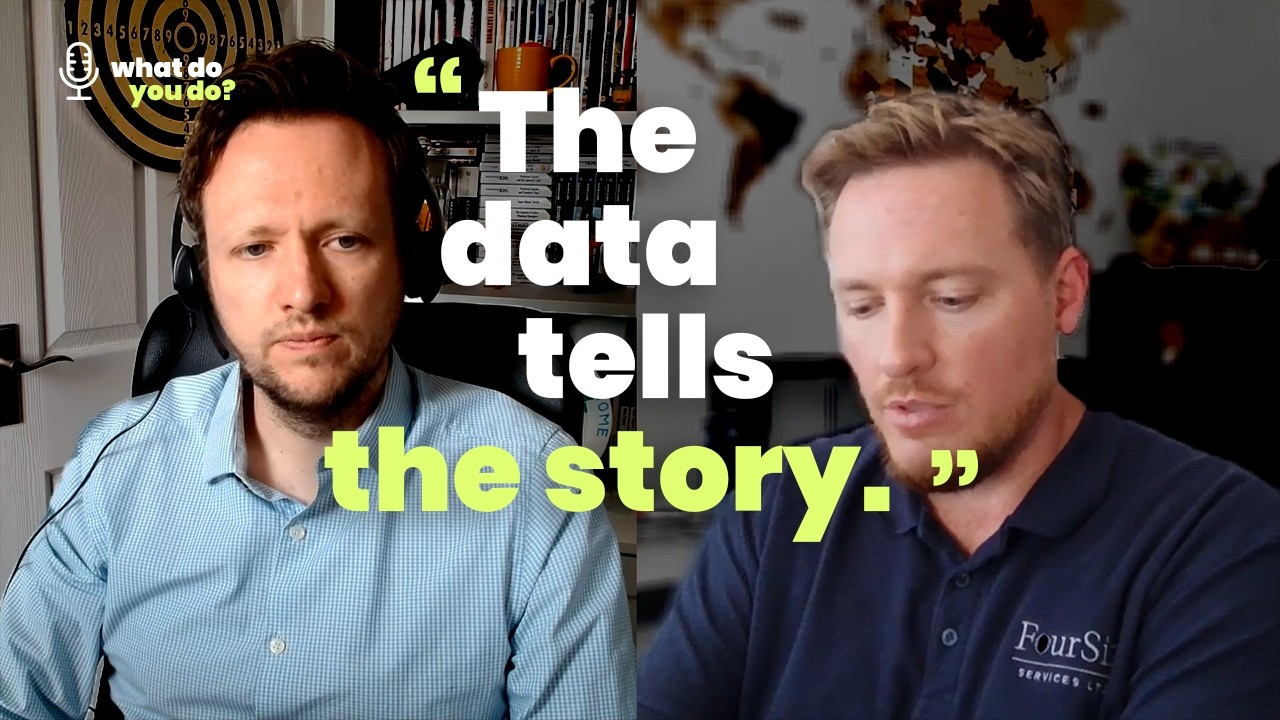
Dan Wilde | Four Six Services
When something goes wrong in your production line, what are the most likely causes? Either operator error or machine error. But if the machine operator is doing their job properly – judged by their own KPIs – and the maintenance technician is keeping the machine running – judged by their own KPIs – then where could the error possibly be?
Manufacturing Performance Partner Dan Wilde makes the case that because the teams have become siloed, neither is seeing the problem from the others point of view, so the problem is only going to get worse. As Dan says, “KPIs are a symptom of the foundations you build.”
Key Takeaways
- OEE (Overall Equipment Effectiveness) multiplies three figures together — availability, performance, and quality — to give one percentage rating of how well time on a production line is actually used.
- Businesses about to scale often have two immediate priorities before anything else: understanding what the data is telling them, and understanding their risk profile so they know what to prioritise.
The Role of a Manufacturing Performance Partner
Manufacturing Silos
A machine operator works on the same machine everyday. He knows how to get it to work optimally, and he knows how to address its issues. His KPIs are most likely based on output and efficiency. But he doesn’t know how the machine works, or what it takes to repair it.
A maintenance technician at the same facility knows exactly how it works, and knows how to fix it if it breaks. His KPIs are based around maintenance strategy and keeping the machines running. But he doesn’t know how to make the machine run optimally.
Both are, as Dan says, “complacent”, not because they’re doing a bad job, but because they accept what is the status quo, what is their responsibility and what isn’t. Both are looking at half of the problem, and as neither have a full grasp of the other’s knowledge, techniques or language, they have become siloed, which causes all kinds of problems when either attempting to scale, or aiming to reduce unplanned downtime.
A Lack of Understanding around Data
Without capturing the right data, and interpreting it correctly, manufacturers are unable to make informed decisions.
During the episode, Dan shares a story from early in his career: he spotted what looked like a straightforward data error – a production line reporting 104% efficiency, which of course, isn’t possible. But correcting the inflated efficiency figure didn’t mean that the line wasn’t less efficient. It actually meant that the line had an opportunity to be more efficient.
This is why Dan explains that the best approach is to start with data. Without accurate figures, teams can’t know where their real priorities are, let alone which risks matter most
What Do We Do?
We founded the What Do You Do? podcast to hear from people like Dan, to understand how to improve the efficiency of your workplace.
Videos, like the one above, are a great way to educate your customers about what you do – find out how we can do it here.
written by
Videographer and video producer with over 15 years experience in both B2B and B2C video marketing. He writes about everything he learned delivering over 1200 video projects across the engineering, education, charity and tech sectors.
