
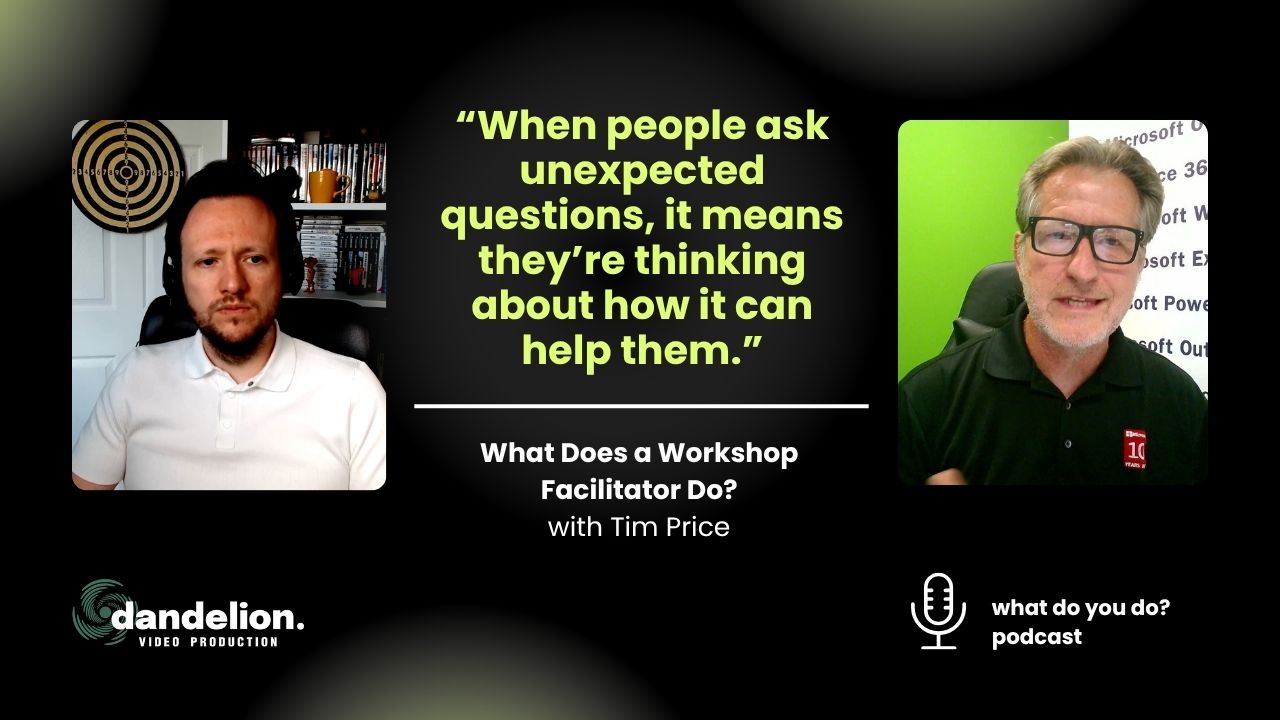
What Do You Do? podcast
Tim Price | Train IT Midlands
Being a workshop facilitator is easy, right? You just stand in front of a room and read out what’s on the screen, or read out your screen share if the workshop is online. As long as you have the specialist knowledge, you can cover any question posed by the audience – what else do you need?
Well, as Workshop Facilitator Tim Price explains in this episode, you need patience. You need to know how to keep the audience engaged (I right this in a single sentence, but it is a hugely important consideration). You need to be prepared to quickly solve any technical issues with your setup, particularly when hosting online. You need to tailor the content for the skill level of your audience. You need to explain it in a language they understand.
Ok, this is just becoming a huge list – listen to the episode to hear more.
Key Takeaways
- Delivering a workshop online is closer to live studio production than just sharing a screen from a single laptop. Your audience might be hundreds or thousands of miles away, so having backups in place is essential to keep things running smoothly.
- Whilst you don’t need a formal qualification to run workshops, it’s a good idea to take courses to help improve your communication and presentation skills.
- Translating the subject matter into a format that your audience understands is key to ensuring engagement during a workshop.
- The best time to look externally for training is when you notice bottlenecks in your company, or are going through a period of change.
The Role of a Workshop Facilitator
Patience and Preparation
In this episode, Tim explains how he became a workshop facilitator late, and by sheer fluke. He had the subject matter knowledge from years of working in a technical corporate environment, but he didn’t have any experience of delivering training. His first experience was to show an older audience how to use Microsoft Office tools, which he describes as the “best training of my life.”
Arguably, this was being thrown in at the deep end, but the experience allowed Tim to learn two crucial lessons that informed his whole training career. Firstly, that patience is absolutely essential. Explaining something once and in technical language isn’t going to cut it. You need to be prepared to answer in-depth, difficult and occassional unexpected questions from people who may have zero understanding of the topic.
Secondly, understanding who your audience are and tailoring the content to them. This can be as simple as explaining that attaching a file to an email can be used to send photos to family and friends – ie. making the content apply to a use-case they need. In addition, a workshop can only proceed as quickly as it’s slowest member, so finding ways ahead of time to segment groups into skill levels keeps everyone engaged.
Technical Redundancy
Before recording the episode, there were some unexplained sound issues. We didn’t actually figure out what the issue was – a simple computer reset fixed it – but what Tim did demonstrate was the sheer amount of redundancy a workshop facilitator needs. He tried four separate microphones before we determined that the issue wasn’t hardware related.
During the episode, Tim also explained that he has an additional computer set up next time to him to both monitor his stream from the audience viewpoint – to make sure that his workshop is being delivered correctly and without delays – but also as a backup device should there be a catastrophic issue with the first.
Imagine logging it to deliver a remote workshop in Stroud, Singapore or Chicago, and your computer dying? A prepared workshop facilitator doesn’t have to.
What Do We Do?
We founded the What Do You Do? podcast to hear from people like Time, to understand how to improve the efficiency of your workplace.
Videos, like the one above, are a great way to educate your customers about what you do – find out how we can do it here.
written by
Videographer and video producer with over 15 years experience in both B2B and B2C video marketing. He writes about everything he learned delivering over 1200 video projects across the engineering, education, charity and tech sectors.
